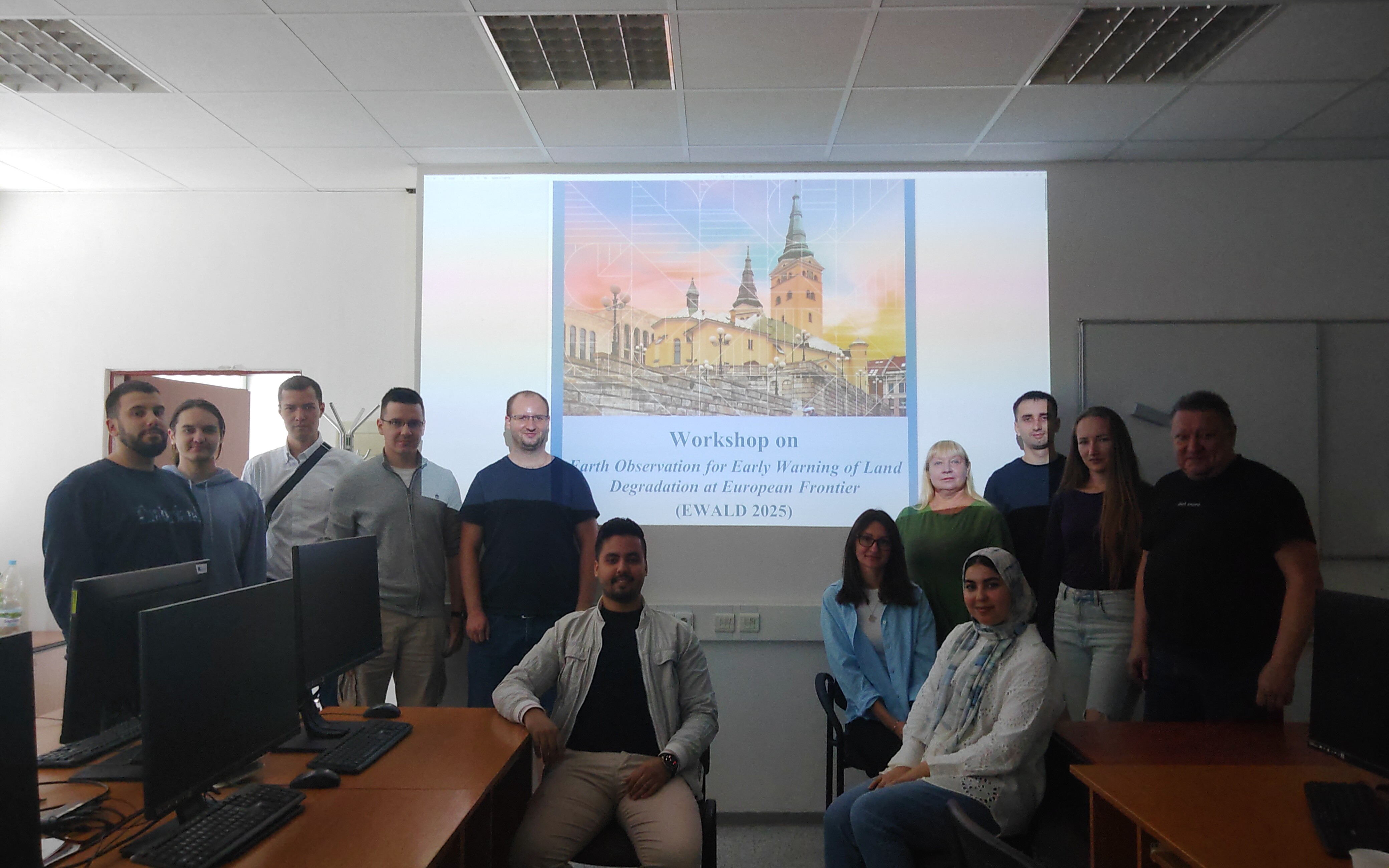
The growing global challenge of land degradation took center stage at the 2025 International Workshop on Earth Observation for Early Warning of Land Degradation at European Frontier (EWALD), held this month with the support of key European and Slovak research initiatives. The event brought together researchers, policymakers, and technology experts to explore innovative tools for monitoring and mitigating the impacts of environmental decline across Europe and beyond.
Organized under the European Union’s Horizon Europe Programme within the EWALD project framework (Grant Agreement No. 101086250), this workshop provided a dynamic platform for dialogue and collaboration in developing early warning systems and geoinformation-based solutions to counter land degradation—one of the most pressing environmental issues globally.
Land degradation, often intensified by natural disasters and desertification, poses increasing threats to agriculture, ecosystems, and human livelihoods. Participants at EWALD 2025 discussed the integration of information technologies (IT), artificial intelligence (AI), and satellite-based earth observation as essential tools for risk assessment and sustainable land management.

The workshop also served as a springboard for cross-border collaboration and youth development. In conjunction with the Slovak Research and Development Agency’s project on AI-driven risk assessment (Project Reg. No. APVV-23-0033), the workshop emphasized the training of young scientists. A special focus was placed on improving their presentation skills and creating opportunities for international research networking.
Keynote speakers delivered insightful presentations on innovative developments in geoinformatics and early warning frameworks, highlighting the role of data analytics and system modeling in addressing environmental challenges. With forward-looking discussions, the EWALD workshop in Žilina was an important gathering in the global effort to combat land degradation, build scientific partnerships, and strengthen environmental resilience through advanced technologies.
From Lusófona University’s side, Prof. João Rodrigues, Lecturer in the Master's of Industrial Engineering and Management of the Faculty of Engineering and Researcher at RCM2+, was present, contributing to the exchange of expertise and reinforcing the university’s commitment to sustainable innovation and global research collaboration.